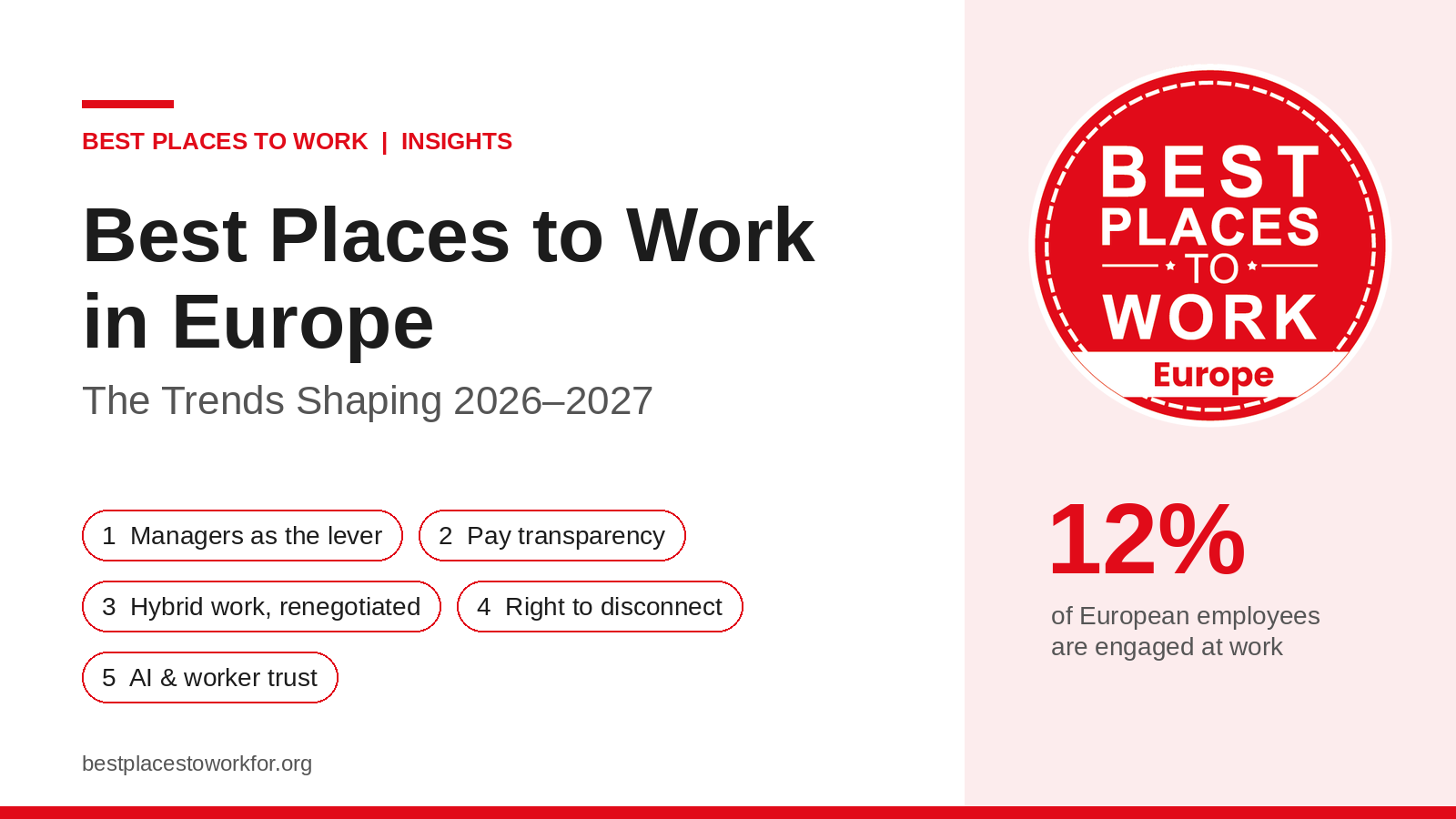
Nearly half of Europeans say they are thriving in life, yet only 12% of employees feel truly engaged at work. Here are the five shifts that set Europe’s best employers apart.
Here’s a strange thing about Europe right now. People say they’re happy with their lives. Nearly half of Europeans describe themselves as thriving. Yet only 12% of employees say they feel truly engaged at work. That’s the lowest figure of any region in the world, and well below the global average of 20%.
And it’s not because jobs are scarce. Confidence in the job market is the highest it’s been in 15 years. People know they have options. They just don’t feel much of a pull towards the work in front of them.
That’s what makes this moment interesting. Europe isn’t one story. In Croatia and Poland, engagement sits at around 7%. In Denmark, it’s 22%. In Romania, it’s 31%. Same continent, same broad economy, completely different experiences at work. So the gap can be closed, and some employers are already doing it.
Here are the five shifts we’re seeing among the organisations that get it right.
1. It starts and ends with managers
If you want to understand why engagement is slipping, look at managers. Worldwide, their own engagement has dropped from 31% in 2022 to 22% in 2025. Younger managers and women managers have been hit hardest.
That matters, because managers set the tone for everyone else. In Germany, only 17% of employees strongly agree that their manager pushes them to grow beyond what they thought they could do. Research suggests managers account for around 70% of the difference in engagement between teams.
Companies are spending heavily on AI and new tools right now. But none of that pays off if the person leading the team is exhausted, unsupported or disengaged themselves.
The employers doing well treat managers as people to invest in, not just channels for HR messages. They coach them, check in with them, and hold them accountable for how their teams actually feel.
2. Pay is about to become a lot more visible
The EU Pay Transparency Directive was supposed to be part of national law everywhere by 7 June 2026. In reality, only Italy, Slovakia, Lithuania and Malta had fully made it law by mid-June. The Netherlands, Sweden, the Czech Republic and Denmark are aiming for January 2027. Germany expects to follow early that year.
Whatever the delays, the direction is clear. Employers with 150 or more staff will publish their first gender pay gap reports by June 2027. Those with more than 250 employees will report every year after that. Smaller companies with 100 to 149 staff have until 2031.
Employees will also have the right to understand how pay and promotions are decided, and to ask for pay information. Employers will have two months to answer.
The smartest companies aren’t waiting for the deadline. They’re sharing salary ranges now, explaining how pay decisions are made, and treating fairness as something employees feel, not just a report they file.
3. Hybrid work isn’t dying. It’s being renegotiated
You’ve probably seen the headlines about companies calling people back to the office. Some of it is real. EY moved to roughly three days a week in the office from July 2026. Mercedes-Benz agreed on four office days as the standard in Germany from January 2027.
But employees are pushing back, and sometimes they’re winning. Airbus put its four-day plan on hold after strikes in Spain, France and the UK. Barclays delayed its three-day rule to 2027 after thousands of staff signed a union letter. In Antwerp, Maersk employees went on strike over the end of home working.
Europe is still more flexible than North America. European banks ask for about 3.4 office days a week on average, compared with 4.2 in North America. The real frustration, though, isn’t about the number of days. It’s about control. About a quarter of EU employees now work hybrid, but fewer than half of them get any real say over when and where they work.
The best employers think about why people should come in, not just how often. Onboarding, mentoring and real collaboration are good reasons. Sitting on video calls at an office desk is not. One analysis found that a single well-planned office day per month raised productivity by 8% and cut staff turnover by a third.
4. Switching off is becoming a right, not a perk
Across Europe, the line between work time and personal time is being written into law. In July 2026, Luxembourg started fining employers who don’t respect the right to disconnect. It joins France, Belgium and Portugal as the countries taking it most seriously. At EU level, the European Commission is consulting on a Quality Jobs Act that could set common rules on remote work, switching off, and the use of algorithms to manage people.
Shorter working weeks are also moving from experiment to serious discussion. Poland is running a government-backed four-day-week pilot with 90 companies and more than 5,000 employees. The final results are due in May 2027.
And there’s good reason to pay attention. Stress levels are high in parts of southern Europe. Around 61% of workers in Greece say they felt a lot of stress the day before, along with 57% in Malta, 56% in Cyprus and 51% in Italy.
Employers who get this right don’t wait for a law to tell them. They set clear expectations about after-hours messages, keep an eye on workload and wellbeing, and try out flexible hours wherever the job allows it.
5. AI is now a question of trust
In July 2026, the EU agreed to delay the toughest AI Act rules for AI used in HR, such as CV screening and candidate assessment. They now apply from December 2027 instead of August 2026.
That’s a delay, not a pass. Any AI used to hire, promote, dismiss, assign tasks or monitor performance is still considered high-risk. Using AI to read people’s emotions at work has been banned since February 2025. And in many countries, employers already have to inform and consult workers before introducing AI tools.
The organisations handling this well are using the extra time wisely. They’re checking their HR tools for bias, involving employee representatives early, and being honest with people about where AI plays a part in decisions that affect them.
So what makes a best place to work in Europe today?
When you step back, these five trends all point to the same thing: trust. New rules are pushing companies to be more open about pay, time and technology. The best employers don’t wait to be pushed. They get there first and use it to earn their people’s confidence.
In practice, that looks like:
- Investing in managers, because they shape how everyone else feels at work
- Being open about pay before the law requires it
- Making office time worth the trip, and giving teams a say in it
- Respecting people’s time off
- Being honest about how AI is used
- Listening to employees regularly, and showing that their feedback leads to real change
European workers know they have choices. The companies that give them a real reason to stay, and can back it up with honest feedback from their own people, are the ones that will stand out as the best places to work in 2027.