Articles
Employee Engagement in Africa: Five Trends Shaping the Workplace in 2026
- 16 October 2026
- •
Only about one employee in five across Sub-Saharan Africa is engaged at work, and one in seven in North Africa and the Middle East. Behind those averages sit very different stories, and a clear agenda for employers.
Employee engagement is falling worldwide. The latest global workplace research puts engagement at 20% in 2025, its lowest level since 2020 and the second decline in a row. Low engagement is estimated to cost the world economy close to $10 trillion a year, about 9% of global GDP.
Africa sits on both sides of that line. Sub-Saharan Africa matches the global average at 19% engaged. North Africa is counted with the Middle East, a region at just 14%, one of the lowest in the world. Here are the five trends that matter most for employers on the continent this year.
1. One continent, very different workplaces
The regional average hides a fourfold gap between countries. In the Democratic Republic of the Congo, 26% of employees are engaged, while in Ghana and Ethiopia only 8% are.
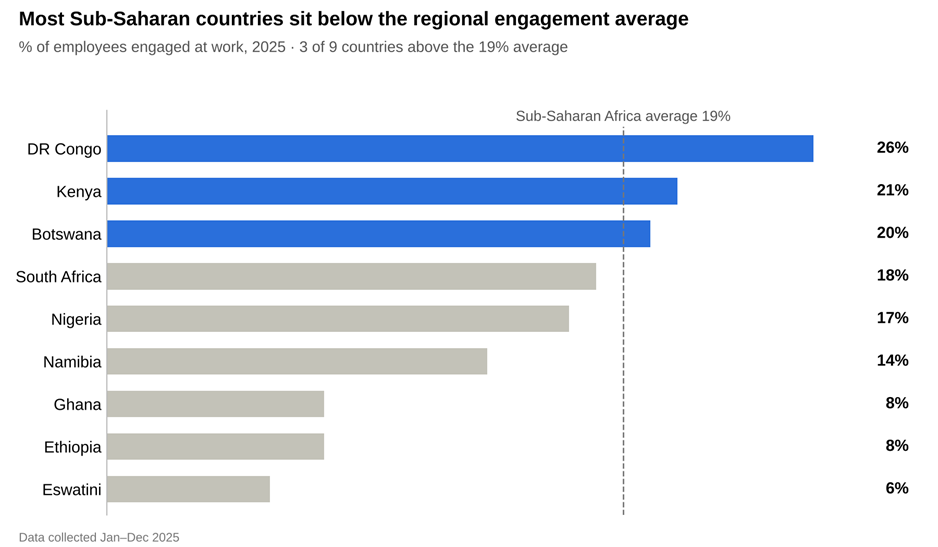
The direction of travel also differs. Namibia has slipped every year, from 23% in 2018 to 14% today, and Botswana dropped five points in a single year. Nigeria has held steady at 17%. For employers working across borders, a single “Africa” engagement strategy will miss what is happening locally.
2. Engaged at work, but not thriving in life
African employees often care about their work while struggling outside it. Only 18% of employees in Sub-Saharan Africa rate their lives as thriving, against 34% globally. Daily stress reaches 46% (40% globally), and 28% report daily loneliness (22% globally).
This gap matters because wellbeing and engagement feed each other. An employee who is engaged but exhausted is a retention risk, not an asset.
South Africa shows how quickly the picture can move. The latest global figures put engagement there at 18%, now below the global average. ADP Research, which measures “full engagement” differently, ranks South Africa second in the world at 27% but down from 31% a year earlier. Both studies point the same way. ADP cites unemployment, inflation and social unrest as pressures, along with isolation among hybrid and remote workers.
3. Managers are the lever, and they are running out of energy
Global research consistently finds that managers drive most of the difference in team engagement. Yet engagement among managers themselves has dropped nine points worldwide since 2022. When the people expected to engage others are disengaged, the decline spreads down the organisation.
Trust follows the same line. PwC’s research in East Africa finds that employees often trust their direct manager more than senior leadership, and that high trust in managers goes with much higher motivation. For African employers, the fastest return on engagement is usually not a new programme. It is giving line managers the time, skills and recognition to lead their teams well.
4. AI enthusiasm is running ahead of company strategy
African workers are adopting AI faster than their global peers. PwC’s Hopes and Fears survey, covering Algeria, Kenya, Morocco, Nigeria and South Africa, found that 64% of African employees used AI at work in the past year, against 54% globally. In South Africa, BCG reports that 79% of frontline white-collar employees use AI regularly, above the 74% global average.
The mood is positive. In East Africa, 68% of workers say they feel curious about AI and 53% excited, while only 28% feel worried. A young, digitally confident workforce is a real advantage.
The risk is a gap between employees and their employers. PwC notes that only about one company in three has built AI deeply into workforce planning, while 49% of roles on the continent could be affected. Employees who are excited about AI but left without training or a clear plan can quickly turn that excitement into anxiety.
5. Security, recognition and growth matter more than perks
African employees are clear about what keeps them committed. PwC found that they place the highest value on job security, recognition, skill development and positive relationships at work. They rank these above autonomy and inclusion programmes.
This reflects economic reality. Where living costs are rising and good jobs are scarce, stability and a visible path to progress carry more weight than office perks. Demographics add to the pressure: more than 60% of Africa’s population is young, and younger employees increasingly expect flexible ways of working.
In North Africa, the warning signs are already visible. In last year’s figures, only 17% of Moroccan employees were engaged, and a large majority said they were looking for a new job. Without recognition and growth, talented people leave, often abroad.
What employers should do next
The trends point to five practical moves for organisations across Africa:
- Measure, then act visibly. Run a structured employee survey at least once a year, with short pulse checks in between. Share the results and the actions that follow.
- Invest in managers first. Train line managers in coaching, feedback and recognition, and look after their own engagement and workload.
- Treat wellbeing as part of engagement. Address stress and isolation directly, through fair workloads, flexible arrangements where possible, and access to support.
- Give AI a human plan. Explain how AI will change roles, and pair every rollout with training so that enthusiasm becomes skill.
- Make growth visible. Clear career paths, fair pay reviews and regular recognition answer what African employees say they value most.
Engagement in Africa is not a lost cause. Countries such as the DRC and Kenya show that it can rise, and the continent’s young, optimistic workforce is ready to commit to employers who earn it. The organisations that listen carefully, and act on what they hear, will be the ones that attract and keep the best talent.
Best Places to Work helps organisations across Africa and beyond measure their employee experience and benchmark it against leading workplaces. Learn more at bestplacestoworkfor.org.
Ready to become a certified Best Place to Work?
Start your certification →